

THE SCIENCE
The evidence behind the bottle
mi-biotics™ is built on a simple idea taken seriously: the active ingredient is not a single strain dropped into a drink, but a fermented multi-millet matrix — a whole-food system engineered so that what it does inside the body can be measured, not just claimed. Below is the evidence, with the studies and the citations, so you can check it yourself.

PATENT
Protected where it
matters most.
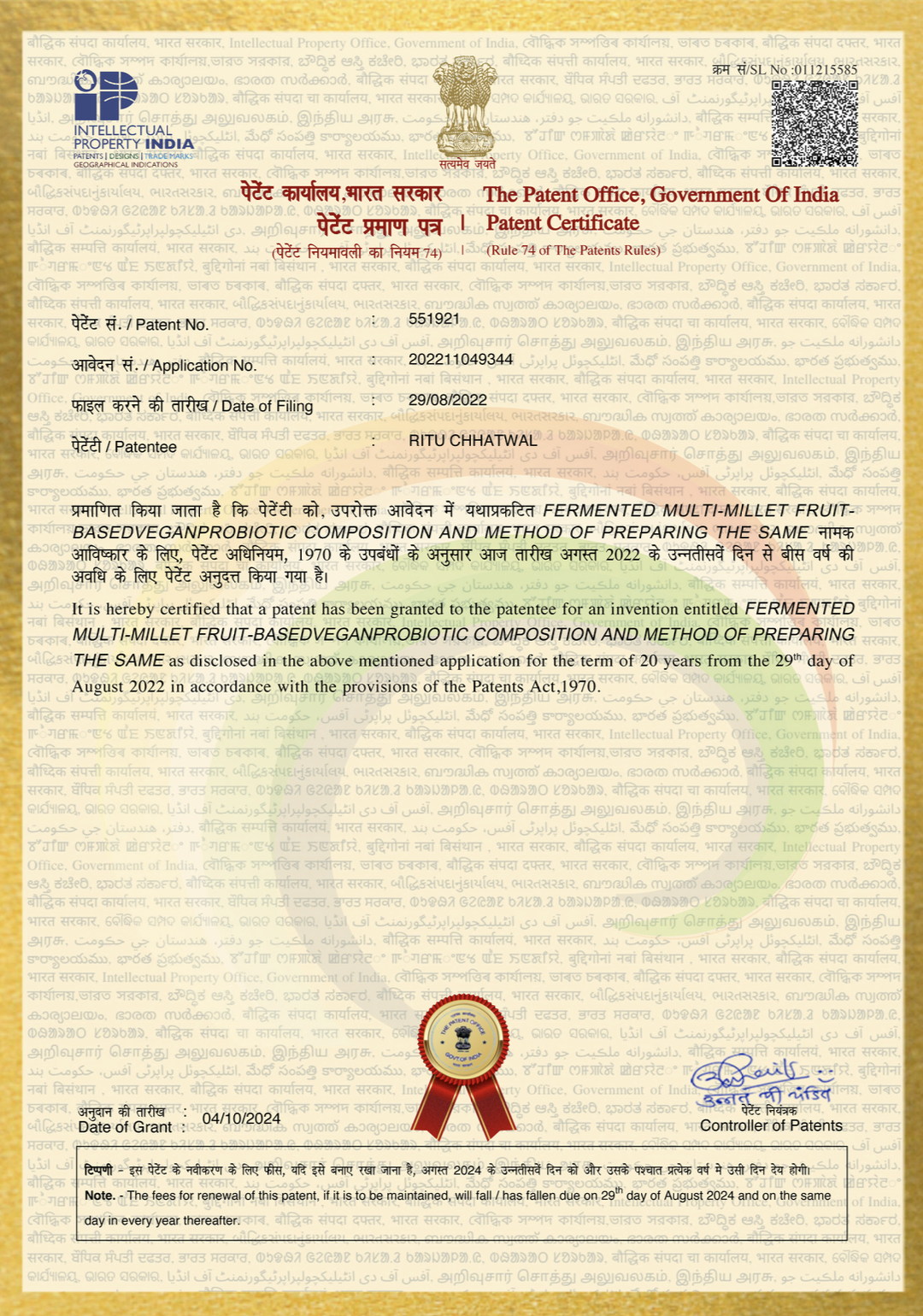
Indian Patent No. 551921 — granted October 2024.
A composition-and-process patent on the fermented multi-millet matrix at the heart of mi-biotics™.
In a category where food inventions are routinely refused as “mere admixtures,” protecting the composition itself — not just a method of making it — is the harder and more meaningful grant.
It secures the matrix in India for twenty years.


INGREDIENTS

Built on the most-studied ingredients in the field
Before anything is fermented, the matrix is built around two of the most thoroughly researched functional ingredients available — the kind most brands pay a premium to use, and then never test beyond the supplier’s own data sheet.

LGG® — Lacticaseibacillus rhamnosus GG, from Chr. Hansen (now part of Novonesis).
Chr. Hansen describes LGG® as the world’s most documented probiotic strain — supported by more than 2,000 scientific publications, including around 300 clinical-study publications — first isolated from a healthy human gut in 1985 and in food use since 1990. The World Gastroenterology Organisation references it in several areas of gut health.

Wellmune® — baker’s-yeast beta 1,3/1,6 glucan, from Kerry.
Kerry describes Wellmune® as the most clinically researched yeast beta-glucan of its kind, and the first ingredient studied as an oral “trainer” of the innate immune system — backed by more than 50 studies, including over a dozen clinical trials in more than 2,300 adults and children.
THE VALIDATION

Why we validated the whole product
—not just the strains
Here is the distinction most people never think to ask about, and it’s the one we’re proudest of.
Almost every functional-food brand that uses an ingredient like LGG® or Wellmune® cites the ingredient maker’s research — studies that tested the strain or the glucan on its own, in isolation. That research is excellent, and it tells you the ingredient works. It tells you nothing about how that ingredient behaves inside this product — in this medium, at this dose, fermented alongside these millets, fruits, and spices. A strain’s behaviour changes with the company it keeps.
So, we did the harder and more expensive thing: we had the finished formulation tested as a whole — the matrix and its cultures working together — against an Asian gut microbiome. As far as we are aware, no comparable product in the category has validated the complete combination this way, rather than borrowing the reputations of its ingredients. The science on this page is about mi-biotics™ as you actually drink it, not about its parts in a test tube somewhere else.
TESTING

Who did the testing?
AMILI
We took mi-biotics™ to AMILI, Singapore’s precision gut-microbiome company. Founded in 2019 by clinicians and scientists — its name stands for Asia Microbiome Library — AMILI built and runs Southeast Asia’s first and only gut-microbiome bank and what it describes as the world’s largest multi-ethnic Asian gut-microbiome database. That Asian reference library is the point: it makes the results relevant to Asian biology specifically, not to a Western gut. AMILI independently validates the gut-health effects of other companies’ products; mi-biotics™ is one of them.
In AMILI’s 2023 study, across the formulations tested, the matrix promoted beneficial bacteria (L. paracasei), suppressed pathogenic species (C. perfringens, E. coli), and increased fibre and carbohydrate breakdown — the activity you’d want from a working probiotic system. In one formulation specifically — the Mixed Fruit & Vegetable formulation at 20% — the study recorded a 99% reduction in TMAO production potential and a 57% increase in microbial serotonin production capacity, the largest effects in the study.